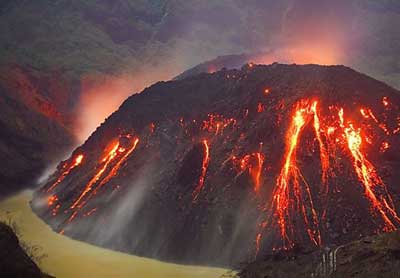
Oberlichter sind Öffnungen in das Dach über eine Lavaröhre, von wo die fließende Lavastrom gesehen werden kann. Diese Löcher werden in der Regel durch den einfachen Zusammenbruch des Daches des Rohres verursacht.
Oia (falsch gesprochen O-I-A) ist der in lateinisch falsch übermittelte Name des Dorfes Ia auf der Insel Santorin (griechisch geschrieben: OIA, gesprochen Ia!)
Oiau is one of 3 volcanic centres of the Dawson Strait Group. It is located on the SE end of Fergusson island, on the peninsula between Kedidia Bay and Numanuma Bay. The volcano consists of a composite cone with a summit crater and has produced an obsidian lava flow of possible Holocene age. -> Ganzen Eintrag ansehen
Nevados Ojos del Salado is the world's highest active volcano. It is located on the Chile/Argentina border, about 20 km south of the road that crosses Argentina-CHile border at Paso de San Francisco.
The mountain has very dry conditions with snow only remaining on the peak during winter. The volcano contains two summit peaks of the same height.
A large explosive eruption took pleace about 1000-1500 years ago and produced pyroclastic flows.
Ojos del Salado is still active and has fumarolic activity at present, but there are no confirmed historical eruptions of Ojos del Salado. A report of minor gas-and-ash emission in 1993 could not be confirmed. The volcano currently shows fumarolic activity. -> Ganzen Eintrag ansehen
Oka Plateau volcano (also known as the East Sayan volcanic field) is a a group of small basaltic cinder cones and associated lava flows in SE Russia near the border with Mongolia, about 200 km west of Lake Baikal.
Eruptions occurred from several vents of the volcano, including the Kropotkin, Peretolchin, and Strariy cinder cones. -> Ganzen Eintrag ansehen
Oki-Dogo volcano is a complex of shield volcanoes forming small islands north of the SW Honshu city of Matsue in the Japan Sea off the west coast of Japan. Most of the volcanic activity took place 800,000-300,000 years ago, but there has probably been activity during the past 10,000 years as well, producing basaltic lava flows and a cinder cone.
Dogo-onsen Hot Spring is Japan's oldest spa. It is said to have been in operation since about 3000 years ago. -> Ganzen Eintrag ansehen
Olca-Paruma volcano is a group of 3 stratovolcanoes forming a 15-km-long E-W ridge along the northern Chile border with Bolivia. There are 3 stratovolcanoes in the complex: Volcán Olca, Cerro Michincha, and Volcán Paruma.
The only known historical activity from the Olca-Paruma complex was a flank eruption between 1865 and 1867 from an excentric flank vent. Since around 1990, volcán Paruma has displayed persistent fumarolic activity. -> Ganzen Eintrag ansehen
Volcán Ollagüe (also known as Oyahué) is a massive andesitic stratovolcano in northern Chile on the border with Bolivia. It contains a dacitic summit lava dome. No historical eruptions have been confirmed from Ollagüe, but there is intense fumarolic activity and a persistent steam plume emanates from a fumarole on the south side of the summit dome.
There are active sulphur mines on the upper western and southern flanks of the volcano which are serviced by a now disused switchback road which reaches 5650 m elevation and rank as one of the highest in the world. -> Ganzen Eintrag ansehen
Omanago volcano consists of 5 closey spaced lava domes in Nikko National Park. They are located north and NW of Nantai volcano.
The highest of the dacitic domes is 2367-m-high Omanago, which later erupted andesitic lavas. Mitsu-dake lava dome, which overlooks the hot spring resort of Lake Yunoko, was radioarbon dated at about 5000 years ago.
Mitsu-dake lava dome overlooks Lake Yunoko hot spring resort. Lake Yunoko is located at an altitude of 1478 m and is 3 km in circumference.
On-take (御嶽山 Ontake-san) is a massive stratovolcano and the second highest in Japan. It is located at the southern end of the Northern Japan Alps.
Its first historic eruption occurred in 1979. A landslide in 1984 was not related to an eruption and produced a debris avalanche and lahar running down valleys south and east of the volcano.
On-take volcano is one of the holy mountains of Japan and the destination for religious pilgrimage since 1792. -> Ganzen Eintrag ansehen
Onikobe volcano is a caldera SW of Kurikoma volcano in northern Honshu, Japan. It is probably extinct, but there are prominent geysers and hot springs in the caldera, known since about 1700 years ago.
In 1938 a new geyser (Benten geyser, or generally called Onikobe geyser) formed at a site where local residents had dug a borehole to create an onsen (hot spring). -> Ganzen Eintrag ansehen
Orte der Kraft sind Plätze, an denen man glaubt, daß dort eine besonders starke Erdstrahlung herrscht, deren Spannungsfeld heilend wirken könne. Oft sind Kirchen, Burgen und Klöster auf solchen Orten gebaut -> Ganzen Eintrag ansehen
Orthodoxie bezeichnet allgemein eine Interpretation einer Lehre, die sich stark an die ursprüngliche Interpretation hält und sich flexiblen Weiterentwicklungen und Anpassungen an veränderte Verhältnisse verweigert. -> Ganzen Eintrag ansehen
Oshima Vulkan (伊豆 大 岛 Izu-Oshima) ist die nördlichste der Izu-Inseln Japan, und einer der weltweit aktivsten Vulkane. Es ist eine meist untergetaucht stratovolcano, dass ein 11 x 13 km Insel bildet. Oshima bricht sehr häufig, im Durchschnitt alle 1-3 Jahre, aber seit 1990 still, was eine ungewöhnlich lange Pause im Vergleich zu ihrer Tätigkeit in historischen Zeiten. Eruptionen am Vulkan Oshima auftreten von beiden Gipfel und Flanke Öffnungen und ihre Laven sind relativ flüssig. Die Eruptionen erzeugen oft Lavafontänen, strombolianische Aktivität, Lavaströme und die Bildung von Lava Seen. -> Ganzen Eintrag ansehen
Oshima-Oshima volcano (渡島大島 in Japanese) forms a small uninhabited 4 km wide island in the Japan Sea island 55 km west of the SW tip of Hokkaido in northern Japan. Oshima-Oshima's eruption in 1741 caused a tsunami that killed almost 1500 people. -> Ganzen Eintrag ansehen
Osore-yama volcano is an active stratovolcano on the Shimokita Peninsula in northernmost Honshu, Japan.
It is known locally also as Yake-yama, or "Burning Mountain". Older residents reported that large fires and clouds were sometimes seen from the summit, but the only confirmed historic activity took place around 1787.
Earthquake swarms have been documented at Osore-yama during the second half of the 20th century, and magma bodies have been detected beneath the volcano. -> Ganzen Eintrag ansehen
Osorno volcano is a symmetrical, glacier-covered stratovolcano in southern Chile, rising above Todos los Santos and Llanquihué lakes.
Osorno is one of the most active volcanoes of Chile. Historical eruptions have often produced produced lava flows. Many eruptions have occurred from both summit and flank vents and fissures, the latter mostly on the west and SW sides. Lava flows from its eruptions have reached Todos los Santos and Llanquihué lakes.
While its historic activity was dominantly effusive, many explosive eruptions which generated pyroclastic flows and surges have been identified to have occurred during the past 14,000 years. -> Ganzen Eintrag ansehen