



Poas Volcano
Updated: 25. Apr. 2024 13:10 GMT -
Stratovolcano 2708 m (8,884 ft)
Costa Rica, 10.2°N / -84.23°W
Aktueller Status: Schwache Aktivität oder Ausbruchswarnung (3 von 5)
Costa Rica, 10.2°N / -84.23°W
Aktueller Status: Schwache Aktivität oder Ausbruchswarnung (3 von 5)
Last update: 24 Apr 2024 (Smithsonian / USGS Weekly Volcanic Activity Report)
Poás is one of Costa Rica´s most active volcanoes, and one of its most frequently visited and prominent ones. It contains a green acid crater lake and during some of its frequent phreatic eruptions, water from the lake is ejected like a geyser.
[smaller] [larger]
Ausbrüche des Poas: 1828, 1834, 1838(?), 1860, 1879(?), 1880, 1888-91, 1895, 1898-1907, 1910, 1910, 1914, 1914-15, 1925, 1929, 1941-46, 1948-51, 1952-57, 1958-61, 1963, 1964-65, 1967, 1969, 1970, 1972-73, 1974-75, 1976, 1977, 1977-78, 1978, 1979-80, 1980, 1981, 1987-90, 1991, 1992, 1992-93, 1994, 1996, 2010, 2011, 2012, 2013, 2014, 2016, 2017
Letzte Erdbeben in der Nähe
 Costa Rica: 2 km al Noreste de San Pedro, Poas.
 Beschreibung
The broad, well-vegetated edifice of Poás has three craters in a N-S line. The 2708-m-high basaltic-to-dacitic complex stratovolcano is cut by a N-S-trending fissure that extends to the lower northern flank, where a parasite volcano (the Congo stratovolcano) and several explosion craters, or maars, most of them lake-filled, have been created.Poás has two summit crater lakes. The southermost one, Botos, is cold, clear has not eruptied for about 7500 years. The other crater lake is geothermally heated and -after Kawah Ijen in Indonesia - is probably the world's second most acidic natural lake. Its pH is near zero.
---
Source: GVP, Smithsonian Institution
Poas Volcano Photos
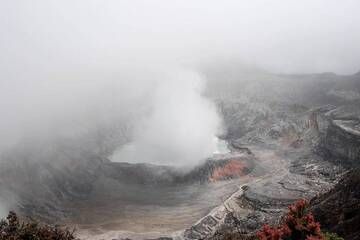
Vulkan Poás in Costa Rica (Photo: Astrid_Furrer)
Latest satellite images