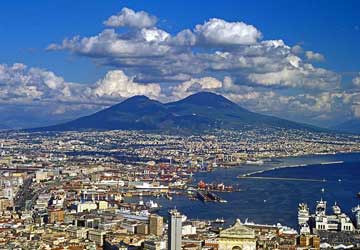
Agung volcano

Mount Agung or Gunung Agung is a active volcano in Bali. This stratovolcano is the highest point on the island. It dominates the surrounding area influencing the climate. The clouds come from the west and Agung takes their water so that the west is lush and green and the east dry and barren.
Volcano type Stratovolcano
Location Bali, Indonesia, 8.342°S / 115.508°E
Summit elevation 3142 m (10,308 ft)
Last eruptions 1808, 1821(?), 1843, 1963-64 (large Plinian eruption on March 16, 1963)
Typical eruption style Highly explosive.

Background:

Mount Agung or Gunung Agung is a mountain in Bali. This stratovolcano is the highest point on the island. It dominates the surrounding area influencing the climate. The clouds come from the west and Agung takes their water so that the west is lush and green and the east dry and barren.
 
Gunung Agung last erupted in 1963-64 and is still active, with a large and very deep crater which occasionally belches smoke and ash. From a distance, the mountain appears to be perfectly conical, despite the existence of the large crater.
 
From the peak of the mountain, it is possible to see the peak of Mount Rinjani on the island of Lombok, although both mountains are frequently covered in cloud.
 
The 1963 eruption of Agung volcano
After more than 100 years of slumber, Mt. Agung came back to life on February 18, 1963. Loud noises and a cloud rising from the crater were noticed, then the ejection of bombs and blocks.
On February 24, 1963, highly viscous lava flows began to travel down the northern flank of the volcano, reaching a length of 7 km in about 18 to 20 days and an elevation of 510 m above sea level. The flows were about 0.5-0.8 km wide and 30-40 m thick. Rough estimates indicate a total volume of these flows of about 50 million cubic meters.
After that phase, the eruption became more and more explosive, and on March 17, 1963, the paroxysmal sub-Plinian eruption took place, generating a eruptino column of 8-10 km height that collapsed to form devastating pyroclastic flows. These flows reached distances of up to 15 km from the crater following vallezs to the south and east, at speeds of about 60 km/hour. Many villages were destroyed and more than 1000 people lost their lives. Heavy tephra fall occurred in areas west of the volcano, where up to 50-70 cm of ash were deposited.
In May, the south peak of the crater wall collapsed, lowering its height for about 200 meters. The lowest crater wall at present is the upper end of Langon river (2600 m).


Background

The symmetrical Agung stratovolcano, Bali's highest and most sacred mountain, towers over the eastern end of the island. The volcano, whose name means "Paramount," rises above the SE caldera rim of neighboring Batur volcano, and the northern and southern flanks of Agung extend to the coast. The 3142-m-high summit of Agung contains a steep-walled, 500-m-wide, 200-m-deep crater.

The flank cone Pawon is located low on the SE side of Gunung Agung. Only a few eruptions dating back to the early 19th century have been recorded from Agung in historical time. Agung's 1963-64 eruption, one of the world's largest of the 20th century, produced voluminous ashfall and devastating pyroclastic flows and lahars that caused extensive damage and many fatalities.

The 1963 eruption of Agung volcano

After more than 100 years of slumber, Mt. Agung came back to life on February 18, 1963. Loud noises and a cloud rising from the crater were noticed, then the ejection of bombs and blocks.
On February 24, 1963, highly viscous lava flows began to travel down the northern flank of the volcano, reaching a length of 7 km in about 18 to 20 days and an elevation of 510 m above sea level. The flows were about 0.5-0.8 km wide and 30-40 m thick. Rough estimates indicate a total volume of these flows of about 50 million cubic meters.
After that phase, the eruption became more and more explosive, and on March 17, 1963, the paroxysmal sub-Plinian eruption took place, generating a eruptino column of 8-10 km height that collapsed to form devastating pyroclastic flows. These flows reached distances of up to 15 km from the crater following vallezs to the south and east, at speeds of about 60 km/hour. Many villages were destroyed and more than 1000 people lost their lives. Heavy tephra fall occurred in areas west of the volcano, where up to 50-70 cm of ash were deposited.

In May, the south peak of the crater wall collapsed, lowering its height for about 200 meters. The lowest crater wall at present is the upper end of Langon river (2600 m).