Current seismic recording from Veniaminof (VNHG station, AVO)
Veniaminof (Alaska Peninsula, USA): Over the past 2 days, AVO has detected gradually increasing seismic tremor beneath Veniaminof and therefore raised the Aviation Color Code to Yellow and the Volcano Alert Level to Advisory. ...plus
Clear web-camera and satellite views currently show nothing unusual at the volcano. Similar seismic activity has been associated with ash emissions at Veniaminof in the past, most recently in 2005.
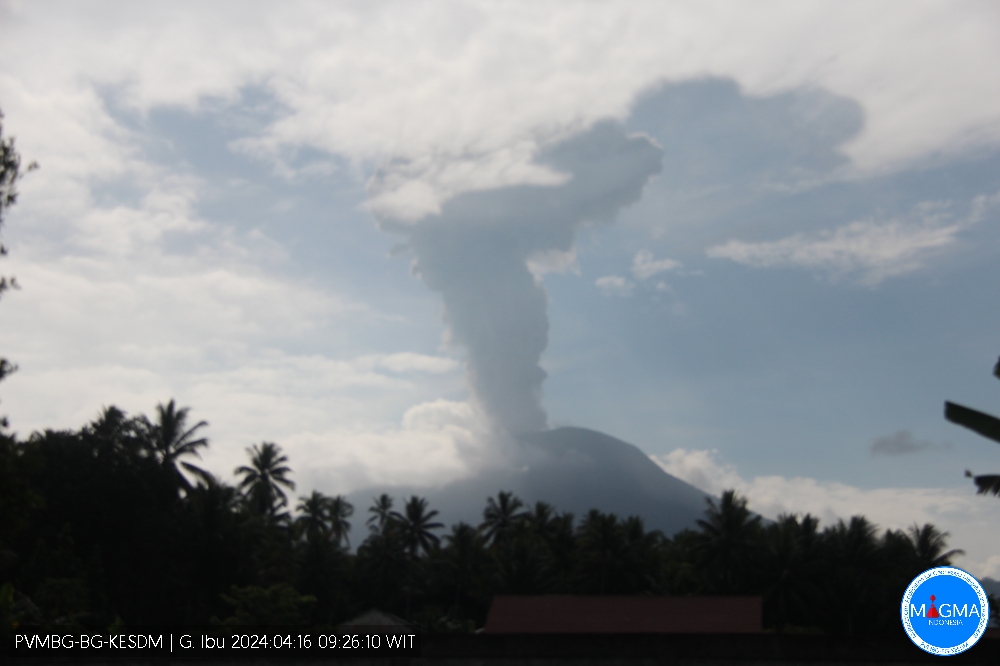
As the Indonesian Volcanological Survey (VSI) specified in its latest bulletin, parts of the active lava dome of the volcano have recently (early June) grown higher than the northern crater rim, where it is cut by a valley extending to the northern feet of the stratovolcano. Therefore, potential continued growth of the dome poses the risk of rockfalls and pyroclastic flows reach the northern flanks, where a number of villages are located, namely Pasilulu and Talen. ...plus
In addition, VSI scientists have detected an increase of seismicity and degassing since early May. This includes volcanic tremor from growing lava dome and deeper earthquakes, possibly related to new magma rising, and the occurrence of notable sulfur smell. Ibu's activity has been characterized by the slow building of a new lava dome inside the breached summit crater since 1999. While present growth rate is still slow, and no or little incandescence is observed at the moment, the new seismic activity could herald a phase of more vigorous activity in the near future. In that scenario, the occurrence of dangerous landslides and pyroclastic flows would be likely and the northern slopes of the volcano should be considered a high risk zone. [moins]
Current seismic recording from Veniaminof (VNHG station, AVO)
Over the past 2 days, AVO has detected gradually increasing seismic tremor beneath Veniaminof and therefore raised the Aviation Color Code to Yellow and the Volcano Alert Level to Advisory. ...plus
Clear web-camera and satellite views currently show nothing unusual at the volcano. Similar seismic activity has been associated with ash emissions at Veniaminof in the past, most recently in 2005. [moins]
Seismic recording from San Cristobal volcano yesterday (CRIN station, INETER)
Seismic recording on 4 June (CNGN station, INETER)
Pavlov (Alaska Peninsula, USA): Weak eruptive activity continues, producing small steam and ash plumes drifting at about 18-20,000 ft (5-6 km) altitude SSE as detected on satellite data (VAAC Anchorage). ...plus
Popocatépetl (Central Mexico): Given the currently low activity (1-3 weak steam and gas emissions per hour), CENAPRED has lowered the alert level back to "Yellow Phase 2". [moins]
Seismic recording from San Cristobal volcano yesterday (CRIN station, INETER)
New eruptions occurred yesterday. The volcano produced a series of 7 small ash emissions between 06:45 to 11:43 am (local time). The explosions were very small and ash plumes only rose up to about 100 m above the crater. ...plus
The new eruptions were followed by a rise in seismic activity in the form of tremor, which rose to about 3 times normal levels during the afternoon. The tremor pulse was still of relatively low energy and in itself not alarming, as the volcano experiences similar phases of elevated seismicity frequently, but given the recent activity, INETER warns that new explosions, possibly larger in scale, could follow with little warning and that air traffic should avoid the area of the volcano. Unconnected to the new eruptive activity, a small mud flow occurred at 17:10 local time on the lower slopes as a result of heavy rainfall, but did not cause damage. [moins]
Seismic recording on 4 June (CNGN station, INETER)
The volcano might be entering a phase of reawakening. A seismic swarm of 49 low magnitude earthquakes and a pulse of volcanic tremor occurred on 4 June, INETER reported in a press release that day. ...plus
The seismic activity started 08:45 am (local time) on 4 June, increased until 10:30 and the eased again. At the moment, the seismicity is calm again. No further reports have been published by INETER, who has not raised the alert level, but recommended to limit access to the volcano's crater as a precaution measure. Cerro Negro is a popular tourist destination, known for "ash surfing" on the steep ashy slopes. The last eruption of the volcano occurred in 1999. [moins]
MODIS hot spot data (past 7 days) for Paluweh volcano (ModVolc, Univ. Hawaii)
Current webcam view of Popocatépetl
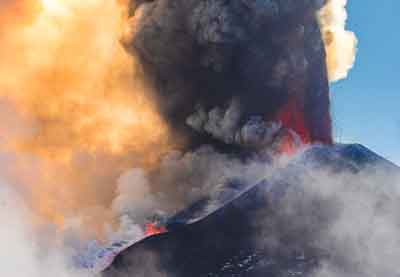
Etna (Sicily, Italy): During a visit to the summit craters today, we could observe a new hot fumarole in the western pit of the Bocca Nuova, increased bluish degassing from a vent in the saddle between the old and new SE crater and hear deep-seated explosions inside the NE crater. ...plus
Apart from this, Etna seems to continue its "sleep". Tremor levels have been low during the past weeks, and no eruptive activity has been observed from any of the summit craters since early May. [moins]
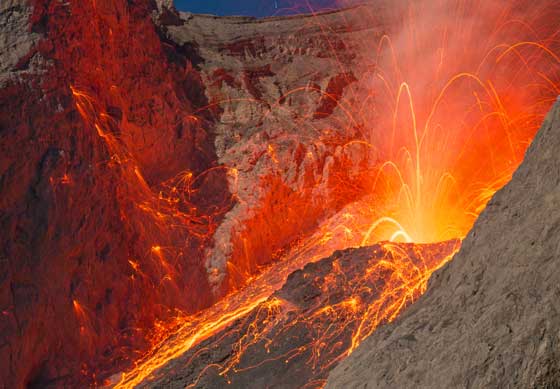
Stromboli (Eolian Islands, Italy): When observed during 3-6 June, the volcano was at normal levels of activity which had not changed significantly since our last visit 2 weeks ago. On the crater terrace, about 7 active vents were present, with eruptions every about 15-20 minutes: the two vents in the NW crater sometimes erupted simultaneously, one with low ejections of blocks, scoria and ash, the other with loud turbine-like jets of gas and lava fragments that often reached about 250 m height. The hornito at the NW crater rim was not seen erupting. ...plus
The 3 connected glowing vents in the central crater produced pulsating steam puffs, but no spattering. ... [read more] ... [show less] [moins]
Plume from Kikai on Aqua satellite image at 04h05 UTC (NASA, via Blog Culture Volcan)
Tolbachik (Kamchatka): Activity continues with little changes, although the slow trend of decreasing seismic activity persists. A small lava lake 20 m across and weak strombolian activity were recently observed by Russian volcanologists who visited the site. Lava flows continue to be alimented and spread mainly to the SE. ...plus
Kikai (Ryukyu Islands): New activity seems to have started from Satsuma-Iwo-jima (Kikai) volcano. A steam / gas and possibly ash-containing plume has been observed on satellite images and a thermal anomaly was visible on recent MODIS satellite data. On yesterday morning's NASA Aqua satellite image, the plume from the volcano was about 70 km long to the SW. A thermal anomaly was visible already on images from 23 May. [moins]
VSI raised the alert level of the volcano on Flores, famous for its 3 differently colored crater lakes, from 1 to 2 ("normal" to "waspada", "watch") on a scaled of 1 to 4, after one of the 3 crater lakes turned from blue to white on 3 June. In addition, a strong smell of sulfur was noted by people from Pemo village a few kilometers south. ...plus
The main risk in case of an eruption would be phreatic explosions, ash falls, and the possibly catastrophic draining of the lake(s) potentially causing large lahars and floods threatening nearby communities near and inside the valleys radiating from the volcano. [moins]
An small eruption occurred last Sunday (2 June) at 8:43 am (local time), preceded by a rise in seismic activity reported by the local volcano observatory. An ash explosion produced a small rising 300-600 m and light ash fall at Gunung Tujuh about 20 km away. According to local news, the sudden eruption caused panik among inhabitants of Sungai Rumpun village and several evacuated their homes. Some climbers who were on the volcano at the time of the explosions returned unharmed. ...plus
The eruption was not signalled by VSI nor VAAC and originally only mentioned in some Indonesian media where it is not worth more than a brief note, given the large number of such events every year. Many more eruptions probably occur around the world without getting the attention of international media. Satellite data showed a weak SO2 anomaly at the volcano on 2 June and a thermal anomaly is regularly visible at the often active volcano's summit. [moins]
Plume from Kikai on Aqua satellite image at 04h05 UTC (NASA, via Blog Culture Volcan)
New activity seems to have started from Satsuma-Iwo-jima (Kikai) volcano. A steam / gas and possibly ash-containing plume has been observed on satellite images and a thermal anomaly was visible on recent MODIS satellite data. On yesterday morning's NASA Aqua satellite image, the plume from the volcano was about 70 km long to the SW. A thermal anomaly was visible already on images from 23 May. ...plus
Kikai south of Kyushu island it is the northernmost of the volcanic Ryukyu island chain that stretches between Japan and Taiwan. [moins]
New ash emissions resumed at approximately 11:00 AKDT (19:00 UTC) this morning and were seen in satellite data and observed by pilots. The new ash plume was drifting SE at approx. 19,000 ft (6 km) a.s.l. altitude. AVO reported weak seismicity beginning at 10:57 AKDT and raised the Aviation Color Code to Orange.
Popocatépetl (Central Mexico): Activity has been reduced during the past days. Occasional explosions produced steam and ash plumes rising about 1 km above the crater and the frequency of small emissions has been about 3 per hour. [moins]
The alert level of the volcano was lowered from "red" to "orange" in response to a declining trend of seismic activity recorded under the volcano. However, seismic activity remains significant and monitoring efforts continue at maximum level. ...plus
The Civil Defence (ONEMI) allowed the 621 evacuees from the Chilean side to return to their homes, while another about 600 evacuees from the Argentina side still remain in evacuation centers. [moins]
Recent MODIS hot spot data for Batu Tara volcano (ModVolc, Univ. Hawaii)
Mayon (Luzon Island): The alert level for the volcano has been raised by PHILVOLCS. A weak incandescence is sometimes observed at the summit, and slight inflation has been detected, suggesting that magma has started to intrude into the volcanic edifice. ...plus
On the other hand, SO2 and seismic parameters have not shown a significant increase, which probably means that an eruption is not imminent. ... [read more] ... [show less] [moins]
The alert level for the volcano has been raised by PHILVOLCS. A weak incandescence is sometimes observed at the summit, and slight inflation has been detected, suggesting that magma has started to intrude into the volcanic edifice. ...plus
On the other hand, SO2 and seismic parameters have not shown a significant increase, which probably means that an eruption is not imminent. However, as the deadly phreatic eruption on 7 May illustrated, sudden explosions can occur any time without particular precursory signs. [moins]
Recent MODIS hot spot data for Batu Tara volcano (ModVolc, Univ. Hawaii)
The volcano remains active with often powerful strombolian explosions, and perhaps the effusion of a lava flow. An elongated thermal hot spot as well as a weak white steam plume visible on recent satellite images suggest that a lava flow might be active from the crater of the volcano these days.
Maintaining the volcano and earthquake news sections on this website, the free Volcano Webcams tool and interactive map widget is a free-time, both time- and server cost intensive effort. If you find the information useful and would like to support us, and help keep it alive and improve it, please consider making a small donation. Thank you!