


Lamongan Volcano
Updated: Apr 24, 2024 00:51 GMT -
stratovolcano 1651 m / 5,417 ft
East Java (Indonesia), -7.98°S / 113.34°E
Current status: normal or dormant (1 out of 5)
East Java (Indonesia), -7.98°S / 113.34°E
Current status: normal or dormant (1 out of 5)
Last update: 9 Dec 2021 (Smithsonian / USGS Weekly Volcanic Activity Report)
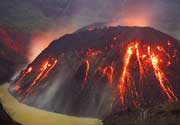
Lamongan is a small stratovolcano in East Java located between the larger Tengger and Iyang-Argapura volcanoes. It is surrounded by numerous craters and cinder cones, forming a volcanic zone stretching 25 km E-W and 16 km N-S., and covering an area of 260 km2.
The volcano had many eruptions in the 19th century, but has probably not erupted since. It is remarkable and unusual for a subduction zone volcano for its many flank vents and relatively effusive eruption style. In the period of intense activity between 1799 and 1898, there were up to 15 basaltic lava flow eruptions.
[smaller] [larger]
Lamongan volcano eruptions: 2003(?), 1953(?), 1898, 1896, 1893, 1891, 1890-91, 1890, 1889, 1888, 1887-88, 1887, 1885-86, 1884, 1883, 1877, 1874, 1872, 1870-71, 1870, 1869, 1869, 1864, 1861, 1859, 1856, 1849, 1847, 1847, 1843-44, 1841-42, 1838, 1830, 1829, 1826, 1824, 1821-22, 1818, 1817, 1808, 1806, 1799
Latest nearby earthquakes
| Time | Mag. / Depth | Distance / Location | |||
Background
The currently active cone of Lamongan has been constructed 650 m to the SW of Gunung Tarub, the volcano's highest point. As many as 27 maars with diameters from 150 to 700 m, some containing crater lakes, and about 60 cinder and spatter cones surround Lamongan volcano to form a wide field.Some of the maars contain lakes, such as Ranu Pakis, Ranu Klakah, and Ranu Bedali, on the eastern and western flanks. Dry maars are predominately located on the northern flanks. None of the Lamongan maars has erupted during historical time, although the possibility of renewed activity from low-lying flank vents pose a significant risk because of the hazard of surges, ballistic ejections and ash fall.
---
Source: GVP
Eruptions of Lamongan volcano
1970 activity & measurements
"Measurement of solfatar temperature in the bottom of the crater resulted 55°C - 95°C. Whereas fumarola did 42° - 55°C.
Temperature of spring nearby the flank, such as Pancuran Spring : 27°C, Pengaron : 28°C, Petung : 26°C, while the average of lakes temperature around the volcano increased from 29°C to 30°C. During transitional season, May - July, the water became dark and many fishes died."
---
From: Directorate of Volcanology and Geological Hazard Mitigation (formerly Volcanic Survey of Indonesia, VSI)
"Measurement of solfatar temperature in the bottom of the crater resulted 55°C - 95°C. Whereas fumarola did 42° - 55°C.
Temperature of spring nearby the flank, such as Pancuran Spring : 27°C, Pengaron : 28°C, Petung : 26°C, while the average of lakes temperature around the volcano increased from 29°C to 30°C. During transitional season, May - July, the water became dark and many fishes died."
---
From: Directorate of Volcanology and Geological Hazard Mitigation (formerly Volcanic Survey of Indonesia, VSI)
1933 possible eruption
On 16 May 1933 detonations and "underground rumblings" (audible tremor?) were heard at Lamongan volcano. New fractures opened at the volcano on the night of 17-18 March, but no lava was reported.
Source:
"Report on the volcanic activity and volcanological research in indonesia during the period 1936–1948", R. W. van Bemmelen, Bulletin of Volcanology
Volume 9, Number 1, 3-29, December 1949
On 16 May 1933 detonations and "underground rumblings" (audible tremor?) were heard at Lamongan volcano. New fractures opened at the volcano on the night of 17-18 March, but no lava was reported.
Source:
"Report on the volcanic activity and volcanological research in indonesia during the period 1936–1948", R. W. van Bemmelen, Bulletin of Volcanology
Volume 9, Number 1, 3-29, December 1949
1924-25 possible eruptions
Underground rumblings and explosions were heard at Lamongan volcano, indicating phreatic activity might have occurred. No deposits can however be confirmed coming from this eruptive period.
Underground rumblings and explosions were heard at Lamongan volcano, indicating phreatic activity might have occurred. No deposits can however be confirmed coming from this eruptive period.
1869 eruption - 8 fatalities
On 6 April 1869, at 07.00, activity from Lamongan increased and a lava flow occurred that burnt 6 houses in Solok village. On 12 September, an explosion took place at the main crater, killing 8 people.
---
Source: Neumann van Padang M, 1951. Indonesia. Catalog of Active Volcanoes of the World and Solfatara Fields, Rome: IAVCEI, 1, 1-271, p 149
On 6 April 1869, at 07.00, activity from Lamongan increased and a lava flow occurred that burnt 6 houses in Solok village. On 12 September, an explosion took place at the main crater, killing 8 people.
---
Source: Neumann van Padang M, 1951. Indonesia. Catalog of Active Volcanoes of the World and Solfatara Fields, Rome: IAVCEI, 1, 1-271, p 149
1847 eruption
This is how one of the typical eruptions of Lamongan were described:
"March 26 - June 26, normal eruption took place at the main crater, parasiter, lava flowing. Every 15 minutes smoke eruption occurred and generated volcanic bomb. On March 30, lava flowed from the summit as far as 167 m. Since May, the activities were up and down. On September 25, occurred ash rain and movement the crater southeastward."
---
Source: Neumann van Padang M, 1951. Indonesia. Catalog of Active Volcanoes of the World and Solfatara Fields, Rome: IAVCEI, 1: 1-271 (p. 149)
This is how one of the typical eruptions of Lamongan were described:
"March 26 - June 26, normal eruption took place at the main crater, parasiter, lava flowing. Every 15 minutes smoke eruption occurred and generated volcanic bomb. On March 30, lava flowed from the summit as far as 167 m. Since May, the activities were up and down. On September 25, occurred ash rain and movement the crater southeastward."
---
Source: Neumann van Padang M, 1951. Indonesia. Catalog of Active Volcanoes of the World and Solfatara Fields, Rome: IAVCEI, 1: 1-271 (p. 149)
Latest satellite images