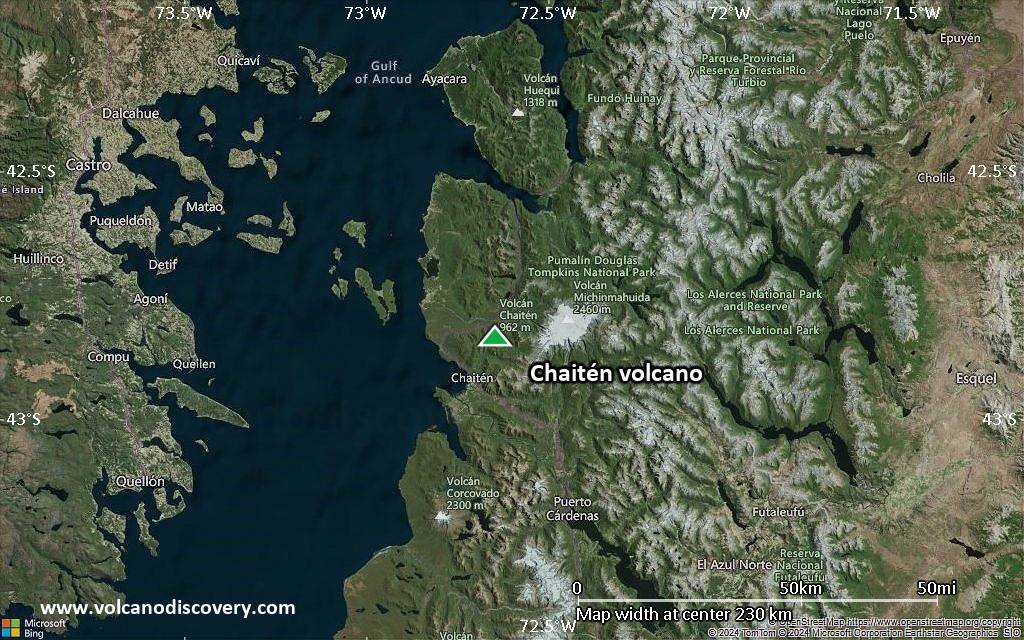
Chaitén volcanoCaldera, lava dome 1122 mSouthern Chile and Argentina, South America, -42.83°S / -72.65°W Chaitén volcano eruptions: 2 May 2008 (plinian eruption) - 2011 Typical eruption style: Explosive, lava dome growth Chaitén webcams / live data Last earthquakes nearby Thursday, Nov 12, 2009

Chaitén's lava dome continues its growth and can shed pyroclastic flows and produce ash eruptions at all times. The alert level remains at its highest (red).
Tuesday, Mar 10, 2009
On 24 February it was reported that a partial dome collapse of Chaitén's Domo Nuevo 1 lava-dome complex a large amount of material accumulated in the basal ring depression surrounding the dome complex and throughout the Blanco River valley. Steam plumes with little ash content and explosions were noted. ...more [read all]
Friday, Feb 20, 2009
Chaitén volcano experienced an increase in activity over the past few weeks. Yesterday, around 11 am local time on 19 Feb., a largere section of the growing lava dome in the crater collapsed, triggering a large pyroclastic flow that came close to the already largely abandoned town of Chaitén. According to press reports, heavy ash falls occurred in the area and the evacuation of the remaining residents of the town is under way. ONEMI reports the eruption of a considerable column of ash. ...more [read all]
Thursday, Jan 15, 2009
It was reported that during 29 December-9 January Chaitén's lava dome continued to grow. Plumes rose to altitudes of 2.6-3.1 km. Block-and-ash flows from frequent spine collapses fell down from the edge. ...more
Friday, Nov 21, 2008
During 12-17November ash plumes from Chaitén continuously rose to altitudes 1.4-3.7 km and a thermal anomaly was detected on satellite photos on 12 November
Wednesday, Nov 12, 2008
The new lava dome of Chaitén volcano continues to grow and emit a dense plume of mainly vapour, typically rising to ca. 2 km altitude. Seismic activity beneath the volcano remains high. ...more
Saturday, Nov 08, 2008
Heavy rainfalls have caused Rio Blanco river (Chaitén r.) to swell dramatically. Floods have broken through the barriers and containment works that have been built since June, destroying at least 30 homes in Chaitén town. ...more [read all]
Friday, Oct 31, 2008
Ash plumes were reported by viewing the volcano webcam and satellite images from 24-28 October. Also a thermal anomaly was detected.
Thursday, Oct 23, 2008
Sunday, Sep 14, 2008
It was reported that during 3-5 September two moderately vigorous plumes from Chaitén were visible on a web camera and rose to altitudes of 2.1-3.1 km. The plumes drifted NW, N, SE, and S. Based on web camera views, analysis of satellite imagery, and information from the Puerto Montt Flight Information Region (FIR), the Buenos Aires VAAC reported that during 3-6 and 8 September, ash plumes rose continuously to altitudes of 1.5-3 km (5,000-10,000 ft) a.s.l. and drifted NW, ESE, and SE.
Thursday, Aug 21, 2008
It was reported that continuous emissions of gas-and-ash plumes from Chaitén were observed on 13 August. ...more
Thursday, Jun 12, 2008
Chaiten's new lava dome continues to grow rapidly inside the crater left by the sub-plinian eruption on 2 May. Over the past week, ash plumes produced by explosions rose to maximum altitude of 3 km (10,000 ft) a.s.l. and drifted SE. ...more [read all]
Thursday, May 15, 2008
Chaitén volcano continues to erupt strong ash plumes although none during the past weeks reached the intensity of the large explosion on May 2nd. Based on observations of satellite imagery, SIGMET reports, and pilot reports, the Buenos Aires VAAC reported that during 7-13 May ash plumes from Chaitén were continuously present and during 7-9 May rose to altitudes of 6.1-10.1 km (20,000-33,000 ft) a.s.l. The plumes drifted E and NE. ...more [read all]
Thursday, May 08, 2008
Saturday, May 03, 2008
The until now rather unknown Chilenean Chaitén volcano erupted violently on 2 May. Chaiten is a small, glacier-free caldera with a lava dome located 10 km NE of the town of Chaitén on the Gulf of Corcovado. There were no known historic eruptions and its last activity might go back several thousands of years.
|
![]() |