

Arenal Volcano

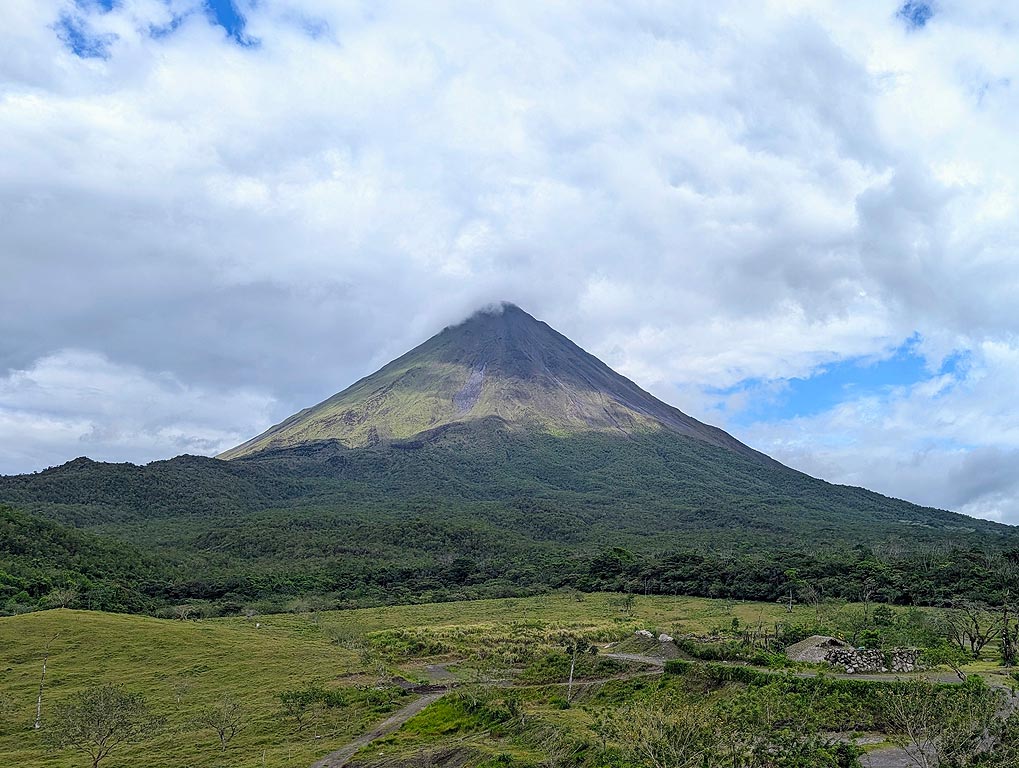
Arenal, a major tourist attraction in Costa Rica, is one of the most active volcanoes of Central America. Since a major eruption in 1968, it has been in near-continuous activity building a lava dome and displaying mild explosive activity from the summit crater.
Arenal volcano eruptions: 1968-2011, 1968 (major explosion), 1922, 1915(?), 1750, 1530, around 1350 (large, sub-Plinian eruption)
Latest nearby earthquakes
| Date and Time | Mag / Depth | Distance / Location | |||
|---|---|---|---|---|---|
| Nov 23, 09:16 pm (GMT -6) | 2? 117 km | 17 km (10.6 mi) to the NW | Costa Rica (unconfirmed) | Info | |
| Thursday, November 20, 2025 GMT (1 quake) | |||||
| Nov 20, 12:25 pm (Universal Time) | 2? 12 km | 26 km (16 mi) to the N | Costa Rica (unconfirmed) | Info | |
| Sunday, November 16, 2025 GMT (1 quake) | |||||
| Nov 16, 11:03 pm (Universal Time) | 2? 98 km | 21 km (13 mi) to the S | Costa Rica (unconfirmed) | Info | |
Background
Volcán Arenal, a beautiful, 1657-m high conical andesitic stratovolcano near Lake Arena, is the youngest and one of the most active stratovolcano in Costa Rica. It is famous for a large explosive eruption in 1968 that killed several people and threw incandescent bombs to 5 km distance from the vent.Arenal lies along a volcanic chain where activity has migrated to the NW over the past 2 million years, from the late-Pleistocene Los Perdidos lava domes through the Pleistocene-to-Holocene Chato volcano, which contains a 500-m-wide, lake-filled summit crater. The earliest known eruptions of Arenal took place about 7000 years ago, and it was active simulataneously with Cerro Chato volcano until the activity of Chato ended about 3500 years ago.
Growth of Arenal has been characterized by periodic major explosive eruptions at several-hundred-year intervals and periods of lava effusion that armor the cone. Arenal's most recent eruptive period began with a major explosive eruption in 1968. Continuous explosive activity accompanied by slow lava effusion and the occasional emission of pyroclastic flows has occurred since then from vents at the summit and on the upper western flank.
Source: GVP, Smithsonian Institution
Significant volcanic eruptions: Arenal volcano
There is one uncertain or discredited eruption in 1915 from Arenal volcano.
| Date | Note | VEI | Deaths | Damage | |
|---|---|---|---|---|---|
| W flank & summit Historical obs./docs. | 3 | ||||
| 2000 Aug 23 (eruption | Historical obs./docs. | 3 | 2 | Info | |
| 1988 Jul 6 (eruption | Historical obs./docs. | 3 | 1 | Info | |
| 1975 Jun 17 (eruption | Historical obs./docs. | 3 | 2 | Info | |
| 1968 Jul 29 (eruption | Historical obs./docs. | 3 | 80 | light | Info |
Historical obs./docs. | 2 | ||||
?? | Uncertain Eruption | 2? | |||
| Summit and NW flank (A2 lava flows) | 0? | ||||
| 2? | |||||
| 4 | |||||
| 4 | |||||
| 4 | |||||
| 4 | |||||
| 4 | |||||
| 4 | |||||
| 4 | |||||
| 4 | |||||
| 4 | |||||
| 4 | |||||
| 4 | |||||
| 0? | |||||
Arenal Volcano FAQ
+When was the last eruption of Arenal volcano?
The last confirmed eruption of Arenal occurred during 1968 - 2010.
+How often does Arenal volcano erupt?
Since 1922, Arenal volcano has had at least 2 historically documented eruptions. This means that it erupts on average every 52 years.
Many eruptions of Arenal have lasted more than one year. In total, the volcano has been in eruption during 44 out of 103 years until now. In other words, Arenal has been active at least one in 2.3 years on average. Note that this value is likely an underestimate, because the known history of eruptions from Arenal is likely incomplete, especially further back in time.
+How active is Arenal volcano at present?
Arenal volcano is very active: Since 1900, it has had 44 eruptions, and been active during 44 years out of 126 as of now. This means, Arenal has been in eruption one in 2.9 years on average. The last eruption was from 1968 until 2010 and ended 15 years ago.
+When was the largest eruption of Arenal volcano?
The largest eruption known from the younger geological history of Arenal volcano occurred in 1400 AD. It ranks as a "vulcanian" eruption with a magnitude 3 on the VEI (Volcanic Explosivity Index) scale.
Latest satellite images
Arenal Volcano Maps